
 Fifteen years ago I interviewed a half-dozen experts about LinkedIn Groups. Here’s how their advice has aged.
By Linda Pophal, MA, SPHR · Strategic Communications, LLC 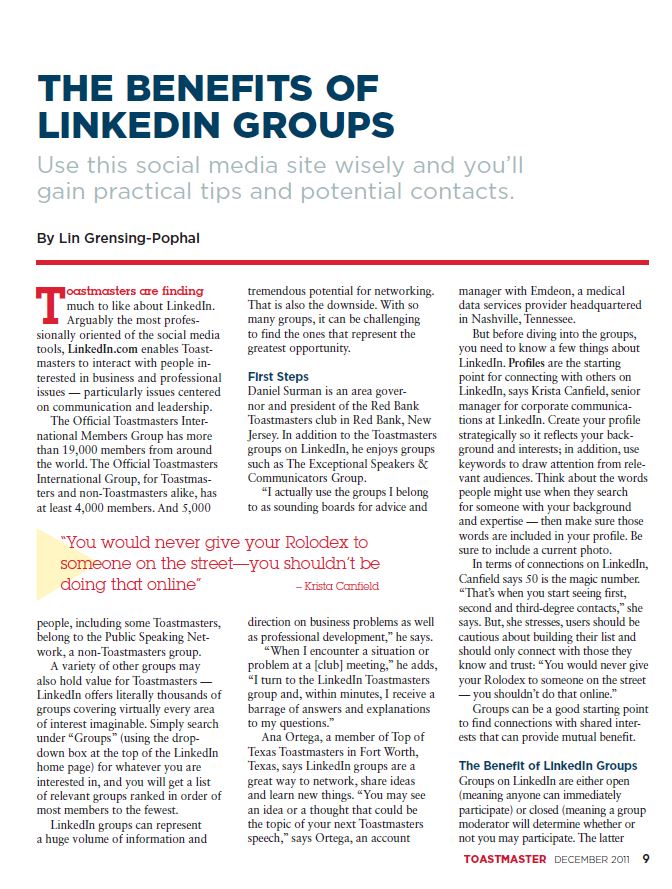
LinkedIn Groups are member-created communities within the LinkedIn platform that allow professionals with shared interests, industries, or affiliations to connect, share content, and engage in discussions. First introduced in 2004, LinkedIn Groups reached peak prominence in the early 2010s before a series of platform changes significantly reduced their visibility and activity. The principles that made Groups valuable in their heyday like strategic participation, genuine engagement, and community over broadcasting remain valid in 2026, even as the tactical landscape has shifted considerably.
I recently came across an article I wrote for Toastmaster magazine in December 2011. The title: “The Benefits of LinkedIn Groups.”
For the piece, I interviewed several LinkedIn practitioners and experts including Wayne Breitbarth, whose book The Power Formula for LinkedIn Success was already earning him national recognition, and Jan Vermeiren, author of How to REALLY Use LinkedIn and founder of Networking Coach.
Reading those quotes 15 years later is a genuinely illuminating exercise.
What the 2011 experts got right
Several of the insights from that article have aged remarkably well.
The ‘Know, Like and Trust’ principle.
Jan Vermeiren described LinkedIn Groups as “the spot on LinkedIn to build your Know, Like and Trust factor,” referencing networking expert Bob Burg’s observation that “all things being equal, people do business with, and refer business to, people they know, like and trust.”
This is as true in 2026 as it was in 2011. The platform has changed. Human psychology hasn’t.
The professionals building real relationships on LinkedIn today are still doing it through genuine engagement, substantive conversation, and consistent presence. That’s exactly what Vermeiren was advocating.
Specific audience focus beats large volume.
Wayne Breitbarth observed that “what makes LinkedIn groups so powerful is that they speak to a specific audience.” He noted that January 2011 was the first time Groups had emerged as LinkedIn’s number-one most-valued feature in his biannual user survey.
That was a remarkable moment of peak enthusiasm that, in retrospect, preceded a steep decline.
But the underlying principle that specificity matters more than scale, and that a focused community delivers more value than a large diffuse one applies equally to the LinkedIn newsletters and creator content strategies that have largely replaced Groups.
Monitor before you participate.
Monique Ramsey, a social media consultant I interviewed for the piece, advised: “That way, you can get a sense of what the key conversations are and then choose to add to the conversation, clarify a situation and position yourself as an expert.” This is still excellent advice, not just for LinkedIn Groups but for any community you’re entering cold. The instinct to broadcast before listening is as common now as it was in 2011, and it’s just as counterproductive.
Your online brand is everything you do.
George Marshall, a Toastmaster leader from the San Francisco area, cautioned that LinkedIn Groups “actually reflect badly on you, not the people you are attacking” when used to vent frustrations. “If you have a pattern of posting complaining messages, you will soon be ignored by most members.” In 2026, with LinkedIn’s algorithm actively surfacing content to audiences far beyond your connections, this principle carries even more weight. Every comment, every post, every reaction contributes to or detracts from how you’re perceived professionally.
Evaluate what’s working and leave what isn’t.
Ana Ortega, a Texas Toastmaster I spoke with, put it simply: “If you participate in a group, but get no feedback, why stay in the group? Periodically evaluate the groups you belong to and determine if they are fitting your needs. Leave the groups that don’t.” That’s a content audit mindset applied to community participation. In 2026, it applies to every channel in your content mix.
What the platform changed
The article captured LinkedIn Groups at what turned out to be almost exactly their peak. Breitbarth’s survey had just registered Groups as the platform’s top feature for the first time. The Official Toastmasters International Members Group had more than 19,000 members. The energy around Groups was real.
Then LinkedIn changed.
Beginning around 2015–2016, the platform restructured its navigation and algorithm in ways that drastically reduced Group visibility. Notifications declined. Activity fell. What had been the center of the LinkedIn community experience became, for most users, a rarely visited backwater.
LinkedIn has made periodic efforts to revive Groups since then, but they have not returned to their former prominence. The community and networking functions they once served are now primarily handled through individual feed content, LinkedIn newsletters, and the direct connection and messaging infrastructure the platform has developed.
The change is worth understanding not just as a LinkedIn story but as a content strategy lesson: even the most effective platform features can lose their relevance quickly when the platform itself evolves.
The professionals who built their entire LinkedIn strategy around Group participation were left holding a playbook that no longer matched the game.
What a smart LinkedIn strategy looks like in 2026
The principles the 2011 experts articulated are still sound. But the tactics have shifted significantly. Here are some you should be considering today.
Prioritize your personal feed content.
Consistent, perspective-driven posts sharing specific observations, asking genuine questions, and engaging thoughtfully with others’ content now deliver the visibility and relationship-building that Group participation once provided.
As I’ve argued in my post on authentic content creation, the content that builds real professional relationships is the content that is genuinely, irreducibly yours.
Build a LinkedIn newsletter.
This is the development I find most significant from a content marketing perspective. LinkedIn’s native newsletter feature which didn’t exist in 2011 allows creators to reach subscribers directly in their notifications and email inboxes, building the kind of consistent audience relationship that Vermeiren’s Know, Like and Trust framework was pointing toward all along.
Engage substantively with others’ content.
Breitbarth has spent 15 years making this argument, and it remains underutilized. Thoughtful, specific comments on others’ posts build visibility and relationships more effectively than most posting strategies. The ‘seek first to understand’ discipline Ramsey advocated for Group participation applies here too.
Use Groups selectively.
Groups haven’t disappeared. In highly specific professional communities like industry associations, alumni networks, and specialized practice areaswhere the niche focus sustains genuine conversation, they can still deliver value.
The advice from my 2011 article still applies: join strategically, monitor before participating, evaluate periodically, and stop doing what isn’t working. As I covered in my post on the editorial calendar as strategic asset, the strategic discipline of knowing where to invest and where to stop is what separates a content strategy from a content habit.
The content repurposing lesson
Daniel Surman, a New Jersey Toastmaster I quoted in the 2011 piece, compared LinkedIn’s potential to the telephone: “at first people didn’t take to it, but if you look around today the phone is indispensable.”
He was right about LinkedIn. Less so about Groups specifically. Which is, in a way, the point: the platform became indispensable. The specific feature he was championing did not. Durable principles outlast specific platforms and features. That’s as true in 2026 as it was in 2011.
There’s also a practical content marketing lesson embedded in this post itself. A 15-year-old article, revisited with honesty about what held up and what didn’t, produces content that is both timely and timeless. It’s content that was grounded in a specific moment while offering perspective that no freshly published piece can provide.
Important takeaway: Your content archive is a resource. Treat it like one.
Frequently asked questions about LinkedIn strategy in 2026
Are LinkedIn Groups still worth using in 2026?
LinkedIn Groups still have value in 2026 but play a narrower role than they did at their peak in the early 2010s. Platform changes beginning around 2015-2016 significantly reduced Group visibility and activity.
Today, Groups work best for highly specific professional communities like industry associations, alumni networks, and specialized practice areas where niche focus sustains genuine conversation. For most B2B professionals and content marketers, personal feed content and LinkedIn newsletters now deliver better results than Group participation as a primary strategy.
What replaced LinkedIn Groups as a community-building tool?
The community and networking functions that LinkedIn Groups served in their peak years—surfacing relevant content, enabling professional conversations, building visibility within a specific audience—are now primarily handled through the LinkedIn feed algorithm, individual content posts, and the LinkedIn newsletter feature.
Newsletters in particular allow creators to build direct subscriber relationships and reach audiences consistently in ways that parallel what the most effective Groups once enabled.
What is the best LinkedIn strategy for building thought leadership in 2026?
Effective LinkedIn thought leadership in 2026 combines consistent personal feed content that offers specific, perspective-driven takes (not generic advice); a LinkedIn newsletter that builds a subscriber relationship and a searchable archive of expertise; substantive engagement with others’ content through meaningful comments; and selective participation in genuinely active niche communities.
Vermeiren’s underlying principles and the Know, Like and Trust framework from 2011 still captures it well. These principles haven’t changed. The tactics for achieving them have.
How has LinkedIn changed since 2011?
LinkedIn had approximately 100-130 million members in late 2011; in 2026 it has over one billion. Groups, once the platform’s most-valued feature, lost prominence after algorithm and navigation changes around 2015-2016.
LinkedIn has introduced newsletters, creator mode, Skills features, and significantly expanded its advertising and analytics capabilities. The platform has shifted from a primarily passive professional directory toward an active content publishing and community engagement ecosystem.
These shifts make content strategy and consistent presence considerably more important than they were 15 years ago.
What’s your LinkedIn strategy looking like in 2026? Are you still using Groups? And for those who were active on LinkedIn in 2011, which experts or principles from that era still resonate with you?
