

The most powerful marketing tool you have hasn’t changed. Here’s how to use it.
By Linda Pophal, MA, SPHR – Strategic Communications, LLC
Storytelling in content marketing is the practice of structuring marketing content around narrative—a relatable situation, a turning point grounded in real experience, and a clear takeaway—rather than around information or promotion alone. Research consistently shows that narrative content is more memorable, more persuasive, and more likely to build the kind of audience trust that drives long-term brand authority than factual or list-based content.
Let’s address the elephant in the room right out of the gate: AI. In the age of AI content creators are feeling stressed, questioning their worth, even questioning the likelihood that they will be able to continue to practice their craft.
But here’s the thing.
The brands that are succeeding in this new AI-fueled reality aren’t succeeding because they have better AI tools.
They’re succeeding because they’re telling better stories.
Storytelling is not a soft skill. It’s not a nice-to-have. It’s the engine of every piece of content that has ever actually moved an audience. And in 2026—with AI capable of producing technically competent, grammatically correct, utterly forgettable content at scale—the ability to tell a real, human story has never been more valuable.
Why stories work when information doesn’t
Continue reading “Why Storytelling Still Wins in the Age of AI”
 GenAI tools are dramatically simplifying the video production process
 I was writing a trends piece for a client recently and, as I often do, I posted a call for input on sites like
  You ask ChatGPT (or one of a growing number of similar automated content generators) to write copy for a blog post that you post to your company’s website. The app wrote the entire copy. Later, you find that another company has lifted the post, verbatim, for use on their own site. Can you sue them for copyright infringement?
  As content marketers have become more familiar with generative AI (GenAI) and the many tools available to leverage its power, they’ve come up with a wide range of business applications and efficiency- and effectiveness-gaining opportunities.
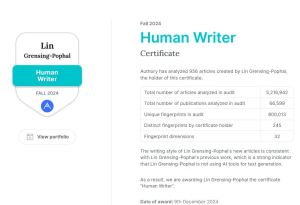

 One of the big downfalls of GenAI is that it currently only draws from content it is trained on that already exists. So, the information it generates is “known.” GenAI can’t (yet) create new material; it can only consolidate and spew back what’s already been created by others. In other words, “it” cannot be innovative.
 I found a recent news story interesting because I was just writing a piece on impending copyright issues related to GenAI for my